
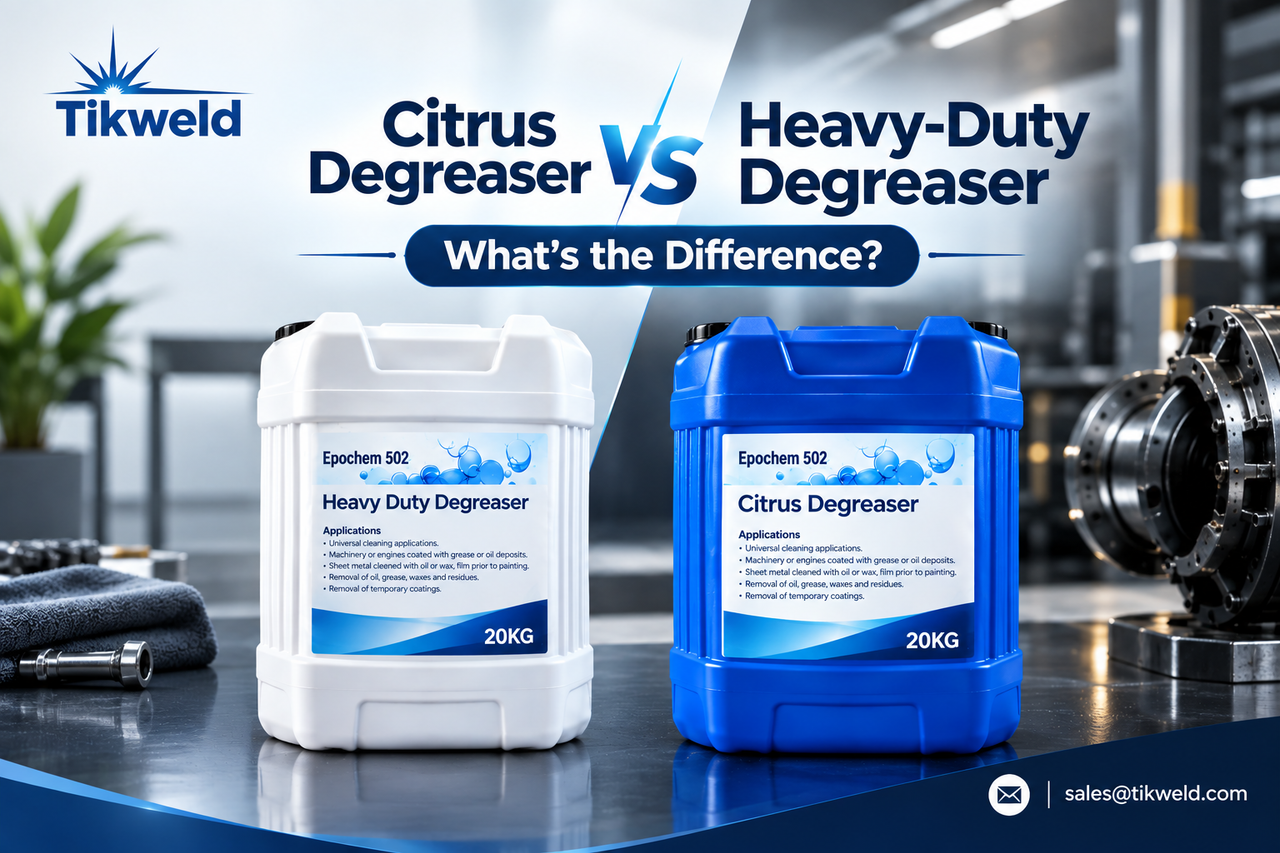
Citrus Degreaser vs Heavy-Duty Degreaser: What's the Difference?
Introduction
Oil, grease and industrial dirt can build up on machinery, workshop equipment, metal surfaces and mechanical components. Choosing the right cleaning chemical is important because different degreasers are formulated for different cleaning requirements.
Two options that may be considered are citrus degreasers and heavy-duty degreasers.
But what is the difference between them, and which one should you choose?
In this guide, we compare citrus degreaser vs heavy-duty degreaser, including their uses, differences and the factors to consider when selecting the right degreaser for your cleaning application.
What is a Citrus Degreaser?
A citrus degreaser is a degreasing product formulated for removing oil, grease and general grime.
The EPOCHEM product range includes EPOCHEM 502 Citrus Degreaser as part of its industrial cleaning and maintenance chemical range.
However, the available product listing identifies the product but does not provide a detailed technical datasheet or formulation information for EPOCHEM 502 Citrus Degreaser.
Therefore, before making specific claims about:
- Its ingredients
- Its concentration
- Surface compatibility
- Dilution ratio
- Exact cleaning performance
- Environmental properties
You should refer to the product's official technical datasheet or Safety Data Sheet (SDS).
In general, citrus degreasers are selected for cleaning applications involving oil, grease and everyday industrial grime, depending on the specific formulation.
What Is a Heavy-Duty Degreaser?
A heavy-duty degreaser is designed for demanding cleaning applications involving oil, grease and stubborn industrial dirt.
The EPOCHEM product range includes EPOCHEM Heavy Duty Degreaser 502 (EP502).
According to the available safety information for EPOCHEM Heavy Duty Degreaser 502, the product is recommended as a general-purpose degreaser.
The datasheet describes it as:
- A slightly viscous amber liquid
- With a solvent odour
- Completely soluble in water
- Having an approximate concentrated pH of 10.1
This makes it suitable for discussion as a general-purpose industrial degreaser, subject to the manufacturer's specific application instructions.
Citrus Degreaser vs Heavy-Duty Degreaser: Key Differences
The main difference between a citrus degreaser and a heavy-duty degreaser is the specific formulation and intended cleaning application.
| Feature | Citrus Degreaser | Heavy-Duty Degreaser |
|---|---|---|
| Primary Purpose | Degreasing and cleaning | General-purpose industrial degreasing |
| Example Product | EPOCHEM 502 Citrus Degreaser | EPOCHEM Heavy Duty Degreaser 502 |
| Product Information Available | Product listing available | Detailed safety information available |
| Exact Formulation | Refer to official datasheet | Alkaline formulation |
| Water Solubility | Refer to official datasheet | Completely soluble in water |
| Concentrated pH | Refer to official datasheet | Approximately 10.1 |
| Best Application | Depends on product formulation | General-purpose degreasing applications |
Important: The exact comparison between these two EPOCHEM products should be confirmed using the official technical datasheets for both products.
The available information provides detailed safety and physical information for the Heavy Duty Degreaser 502 but does not provide equivalent technical information for the Citrus Degreaser.
How Citrus Degreasers Are Used
The specific application of a citrus degreaser depends on the product formulation.
Generally, a citrus degreaser may be considered for removing:
- Oil
- Grease
- Industrial dirt
- Workshop grime
- Surface contamination
Before using a citrus degreaser, check:
- The product label
- Technical datasheet
- Safety Data Sheet
- Recommended surface compatibility
- Application instructions
This is particularly important because different citrus degreaser formulations can vary significantly.
How Heavy-Duty Degreasers Are Used
Heavy-duty degreasers are commonly selected for demanding cleaning applications involving oil and grease.
The available EPOCHEM 502 safety information identifies the product as a general-purpose degreaser and confirms complete solubility in water.
When selecting a heavy-duty degreaser, consider:
- Type of contamination
- Thickness of grease
- Surface material
- Cleaning method
- Water availability
- Product instructions
Citrus Degreaser vs Heavy-Duty Degreaser: Which Is Better for Heavy Grease?
The answer depends on the specific product formulation and cleaning application.
A product described as a heavy-duty degreaser may be selected for demanding industrial cleaning requirements involving heavy oil and grease.
However, it would not be accurate to claim that one product is automatically stronger or more effective than another without comparing:
- Product formulation
- Concentration
- Application instructions
- Recommended contaminants
- Surface compatibility
For the EPOCHEM products discussed in this article, the available technical information is more detailed for EPOCHEM Heavy Duty Degreaser 502 than for EPOCHEM 502 Citrus Degreaser.
For that reason, users should consult the official product information before selecting either product for a specific heavy-grease application.
When Should You Choose a Citrus Degreaser?
Consider a citrus degreaser when:
- The product formulation is suitable for the contamination.
- The product is compatible with the equipment surface.
- The manufacturer's instructions recommend it for your cleaning application.
- You are dealing with oil, grease or general industrial grime.
Before purchasing, confirm:
What Are You Cleaning?
Is the surface:
- Metal?
- Plastic?
- Painted?
- Rubber?
- Machinery components?
What Are You Removing?
Are you dealing with:
- Light oil?
- Heavy grease?
- General dirt?
- Industrial grime?
The right product should be selected based on the answers to these questions.
When Should You Choose a Heavy-Duty Degreaser?
A heavy-duty degreaser may be considered when:
- You require a general-purpose degreaser.
- Oil and grease buildup needs to be removed.
- A water-soluble product is suitable for your cleaning process.
- The product is compatible with the equipment surface.
According to the available safety information, EPOCHEM Heavy Duty Degreaser 502 is completely soluble in water and has an approximate concentrated pH of 10.1.
Always follow the manufacturer's instructions regarding:
- Application
- Dilution
- Contact time
- Rinsing
- Disposal
How to Choose Between Citrus and Heavy-Duty Degreasers
Before selecting either product, consider the following.
1. Type of Contamination
Determine whether you are dealing with:
- Light grease
- Heavy grease
- Oil
- Industrial dirt
- Mixed contaminants
Different formulations may perform differently depending on the contamination.
2. Surface Material
Identify the surface before applying a cleaning chemical.
Common surfaces include:
- Steel
- Aluminium
- Painted metal
- Plastic
- Rubber
Always check product compatibility.
3. Cleaning Method
Consider how the product will be applied.
Depending on the product, application may involve:
- Spraying
- Brushing
- Wiping
- Rinsing
Do not assume that both products use the same application method.
4. Water Availability
The available EPOCHEM Heavy Duty Degreaser 502 information states that it is completely soluble in water.
For the citrus degreaser, confirm the recommended cleaning and rinsing method from the product documentation.
Citrus Degreaser vs Solvent Degreaser
Citrus degreasers and solvent degreasers are different categories of cleaning products.
For example, the EPOCHEM range includes:
- EPOCHEM 502 Citrus Degreaser
- EPOCHEM 530 Standard Solvent Degreaser
According to the available product information, EPOCHEM 530 is designed to penetrate oil and grease-bound dirt and can be applied by spraying, brushing or swabbing before removal with water.
If your cleaning application involves particularly heavy oil and grease-bound dirt, you may want to compare the requirements with the product instructions for an appropriate solvent degreaser.
Common Mistakes to Avoid When Choosing a Degreaser
Choosing Based on the Product Name Alone
Terms such as “citrus” and “heavy-duty” do not automatically tell you everything about a product's:
- Formulation
- Surface compatibility
- Application method
- Cleaning strength
Always review the product documentation.
Using the Same Degreaser for Every Surface
Different materials can react differently to industrial cleaning chemicals.
Check compatibility before use.
Ignoring Safety Information
Industrial degreasers should be handled according to their product safety documentation.
For EPOCHEM Heavy Duty Degreaser 502, the available safety information recommends suitable gloves and eye or face protection and states that concentrated product handling may require chemical-resistant gloves and other protective equipment.
Safety Tips When Using Industrial Degreasers
Before using a citrus or heavy-duty degreaser:
- Read the product label.
- Review the Safety Data Sheet.
- Wear appropriate PPE.
- Avoid unnecessary skin and eye contact.
- Ensure suitable ventilation where required.
- Do not mix cleaning chemicals unless instructed.
- Follow recommended disposal procedures.
For additional guidance on workplace chemical safety, handling and hazard communication, refer to OSHA's Hazard Communication resources.
Frequently Asked Questions
What is the difference between a citrus degreaser and a heavy-duty degreaser?
The main difference depends on the specific product formulation.
A citrus degreaser is marketed as a citrus-based degreasing product, while a heavy-duty degreaser is intended for more demanding or general-purpose industrial degreasing applications.
Always compare the product's technical documentation before choosing.
Is a citrus degreaser stronger than a heavy-duty degreaser?
Not necessarily.
Cleaning performance depends on the specific formulation, concentration and application.
Without comparing the official technical data for both products, it would not be accurate to say that one is universally stronger.
Can citrus degreaser remove heavy grease?
The ability to remove heavy grease depends on the specific product formulation and recommended application.
Check the manufacturer's instructions before use.
Can heavy-duty degreasers be rinsed with water?
The available safety information for EPOCHEM Heavy Duty Degreaser 502 states that it is completely soluble in water.
Always follow the manufacturer's instructions regarding rinsing.
Related Article
Heavy-Duty Degreaser vs Solvent Degreaser: Which Is Right for Your Equipment?
Conclusion
Both citrus degreasers and heavy-duty degreasers are designed for cleaning applications involving oil, grease and industrial dirt. However, the right choice depends on the specific formulation, the contamination and the surface being cleaned.
The available product information identifies EPOCHEM 502 Citrus Degreaser as part of the EPOCHEM industrial cleaning product range, while EPOCHEM Heavy Duty Degreaser 502 is supported by available safety information describing it as a general-purpose, water-soluble and alkaline degreaser.
Before choosing either product, review the manufacturer's product information and confirm that it is suitable for your cleaning application.
Explore Tikweld's range of industrial degreasers and cleaning chemicals to find the right solution for machinery, equipment and industrial maintenance applications.
Newest Guide & Blog Updates

Inverter Welding Machines and Prices in Nigeria (2026)
Introduction Welding machine prices in Nigeria (October 2026) range from about ₦ PRICE for a 200A i...

Free Online Epoxy Flooring Training in Nigeria Scheduled for October 2026
Professionals, artisans, contractors and individuals interested in epoxy flooring will have an oppor...
Epoxy Resin and Hardener Mixing Ratio: A Complete Guide
Introduction If you are using epoxy resin for flooring, coating, casting or other applications, one...

How Much Epoxy Resin Do You Need for Flooring? Coverage & Calculation Guide
How Much Epoxy Resin Do You Need for Flooring? Coverage & Calculation Guide Calculating the amount o...
How to Remove Heavy Oil and Grease from Industrial Equipment
Introduction Heavy oil, grease and industrial grime can build up on machinery, engines, mechanical c...
Antirust Degreaser: How It Cleans and Protects Metal Surfaces
Introduction Industrial equipment and metal components are often exposed to two common maintenance p...