
Epoxy Resin and Hardener Mixing Ratio: A Complete Guide
Introduction
If you are using epoxy resin for flooring, coating, casting or other applications, one of the most important things to get right is the epoxy resin and hardener mixing ratio.
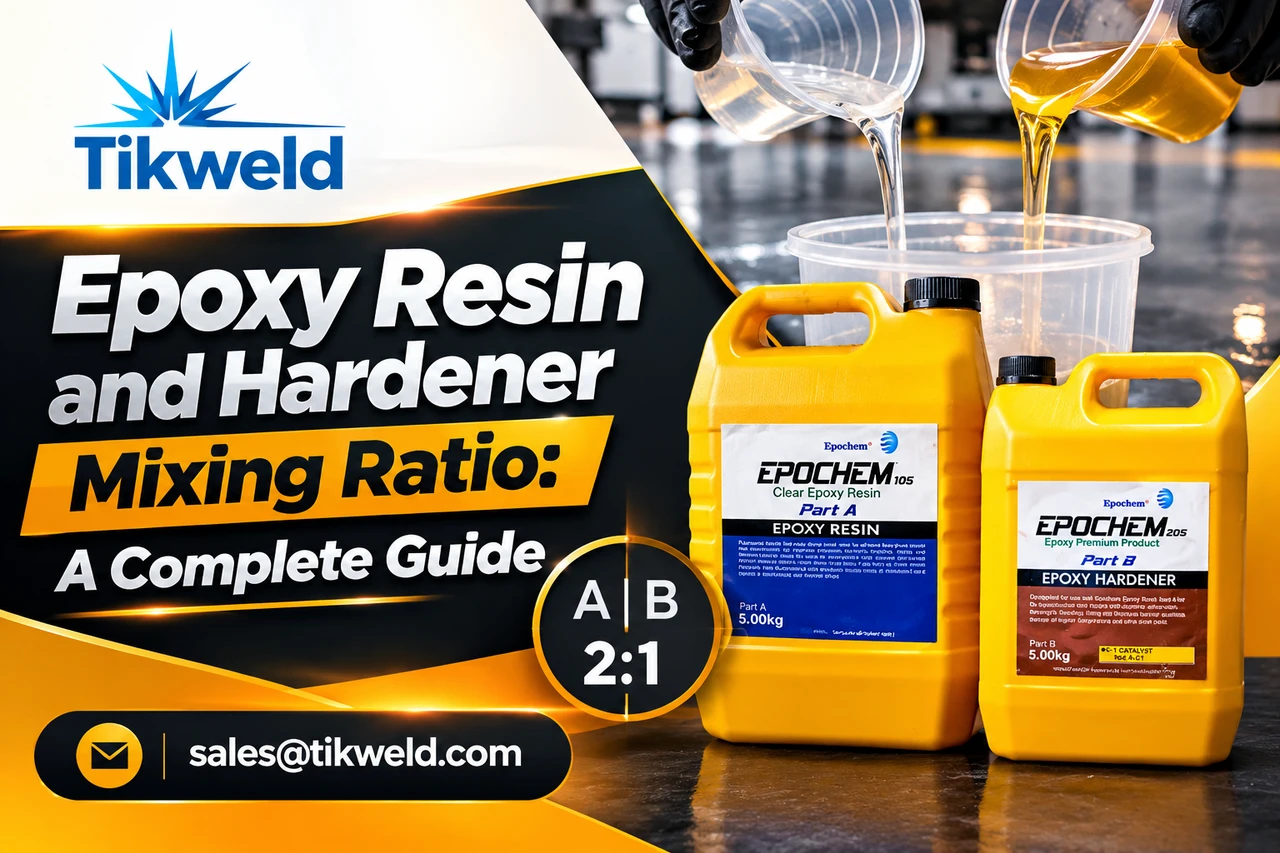
For the Epochem 105 Resin and Epochem 205 Hardener, the required mixing ratio is:
2:1 — Resin to Hardener
That means you mix 2 parts Epochem 105 Resin with 1 part Epochem 205 Hardener.
For example, 2 kg of resin requires 1 kg of hardener, giving you 3 kg of mixed epoxy.
Understanding this ratio is important, but there is another question that matters when working on an epoxy flooring project: how much mixed epoxy will you actually need?
This guide explains the 2:1 ratio, shows how to calculate the quantities, and uses a practical flooring example to make the calculation easier.
What Is the Epoxy Resin and Hardener Mixing Ratio?
The Epochem 105 Resin and Epochem 205 Hardener system uses a 2:1 resin-to-hardener mixing ratio. Tikweld's product information specifies the 2:1 ratio for Epochem 105 and Epochem 205. (Tikweld)
In simple terms:
2 parts Epochem 105 Resin + 1 part Epochem 205 Hardener
Here are some common mixing quantities:
| Epochem 105 Resin | Epochem 205 Hardener | Total Mixed Epoxy |
|---|---|---|
| 1 kg | 0.5 kg | 1.5 kg |
| 2 kg | 1 kg | 3 kg |
| 4 kg | 2 kg | 6 kg |
| 6 kg | 3 kg | 9 kg |
| 10 kg | 5 kg | 15 kg |
| 20 kg | 10 kg | 30 kg |
The important point is that the ratio remains 2:1, regardless of how much material you are preparing.
How Do You Calculate the Amount of Hardener?
The calculation is straightforward.
Formula:
Hardener required = Resin quantity ÷ 2
For example:
If you have 2 kg of resin:
2 ÷ 2 = 1 kg hardener
Therefore:
2 kg Epochem 105 Resin + 1 kg Epochem 205 Hardener = 3 kg mixed epoxy
If you have 10 kg of resin:
10 ÷ 2 = 5 kg hardener
Therefore:
10 kg resin + 5 kg hardener = 15 kg mixed epoxy
If you have 20 kg of resin:
20 ÷ 2 = 10 kg hardener
Therefore:
20 kg resin + 10 kg hardener = 30 kg mixed epoxy
This calculation can be used whenever you need to maintain the 2:1 ratio.
How Much Epoxy Do You Need for Flooring?
The mixing ratio tells you how much resin and hardener to combine, but it does not by itself tell you how much material a floor requires.
For an epoxy flooring project, material requirements can depend on factors such as:
-
Floor area
-
Application thickness
-
Surface condition
-
Type of epoxy flooring system
-
Surface preparation
-
Number of coats
-
Application method
-
Product coverage
For example, a flooring calculation using a 2 mm application thickness can use the following practical coverage:
2 kg resin + 1 kg hardener = 3 kg mixed epoxy
This quantity covers approximately 1.5 m² at 2 mm thickness. (GZ Supplies)
Using that example, you can estimate the material required for larger floor areas.
Epoxy Flooring Material Calculation
Based on the 2 kg resin + 1 kg hardener quantity covering approximately 1.5 m² at 2 mm thickness:
| Floor Area | Epochem 105 Resin | Epochem 205 Hardener | Total Mixed Epoxy |
|---|---|---|---|
| 1.5 m² | 2 kg | 1 kg | 3 kg |
| 3 m² | 4 kg | 2 kg | 6 kg |
| 5 m² | 6.67 kg | 3.33 kg | 10 kg |
| 10 m² | 13.33 kg | 6.67 kg | 20 kg |
| 20 m² | 26.67 kg | 13.33 kg | 40 kg |
| 50 m² | 66.67 kg | 33.33 kg | 100 kg |
| 100 m² | 133.33 kg | 66.67 kg | 200 kg |
These figures are material calculations based on the stated 2 mm coverage example. Actual project requirements can vary depending on the flooring system, substrate and application conditions.
Example: How Much Epoxy Is Needed for a 10 m² Floor?
Let's use a 10 m² floor as an example.
At 2 mm thickness:
1.5 m² requires approximately 3 kg of mixed epoxy.
Therefore:
10 ÷ 1.5 = approximately 6.67
You would need approximately:
13.33 kg Epochem 105 Resin
and
6.67 kg Epochem 205 Hardener
That gives:
20 kg of mixed epoxy
So, for a 10 m² floor at this example coverage rate:
13.33 kg Resin + 6.67 kg Hardener = 20 kg Mixed Epoxy
This type of calculation can help you estimate the resin and hardener quantities before purchasing materials.
Does Increasing the Thickness Increase Material Consumption?
Yes.
The 1.5 m² coverage example above is based on a 2 mm thickness. If a project requires a thicker application, more material will generally be required.
This is why you should not calculate epoxy requirements based on floor area alone.
For example, a 20 m² floor does not automatically require the same amount of epoxy regardless of whether the intended system is 1 mm, 2 mm, 3 mm or another thickness.
The required quantity should be calculated according to the specified flooring system and application thickness.
Resin and Hardener Are Only Part of an Epoxy Flooring System
One important thing to understand when calculating epoxy flooring costs is that the resin and hardener are not necessarily the entire flooring installation.
A complete epoxy flooring project may involve:
-
Surface preparation
-
Grinding
-
Cleaning
-
Epoxy mortar
-
Primer
-
Scratch coat
-
Topcoat
-
Self-leveling layers
-
Labour
-
Tools and equipment
-
Other project-specific requirements
Therefore, the amount you spend on Epochem resin and hardener should not automatically be treated as the complete cost of installing an epoxy floor. (GZ Supplies)
This distinction is particularly important when preparing a quotation for a commercial, industrial or residential flooring project.
How to Mix Epochem 105 Resin and Epochem 205 Hardener
Once you have calculated the required quantities, proper mixing is the next step.
Step 1: Measure the Resin
Measure the required quantity of Epochem 105 Resin.
For example:
10 kg resin
Step 2: Calculate the Hardener
Apply the 2:1 ratio:
10 kg ÷ 2 = 5 kg
Therefore, you need:
5 kg Epochem 205 Hardener
Step 3: Combine the Components
Place the measured resin and hardener into a suitable clean mixing container.
Step 4: Mix Thoroughly
Mix the two components thoroughly to ensure the resin and hardener are properly combined.
Accurate measurement and proper mixing are important when preparing epoxy systems.
Step 5: Apply According to the Product Requirements
Once mixed, the material should be used according to the product instructions and the requirements of the specific application.
What Happens If You Add Too Much Hardener?
Do not assume that adding more hardener will automatically make the epoxy cure faster or perform better.
The resin and hardener are designed to work at a specified proportion.
Changing the recommended ratio can affect the curing process and the resulting material properties.
For Epochem 105 and Epochem 205:
Maintain the 2:1 Resin-to-Hardener Ratio.
What Happens If You Use Too Little Hardener?
The same principle applies when using too little hardener.
If the resin and hardener are not combined in the specified proportion, the mixture may not cure as intended.
This is why measuring the components accurately is preferable to estimating the quantities.
Common Epoxy Mixing Mistakes to Avoid
1. Guessing the Quantities
Do not simply pour resin and hardener together based on visual estimates.
Calculate and measure the quantities.
2. Changing the 2:1 Ratio
Do not add extra hardener because you think it will improve curing.
Follow the specified ratio.
3. Poor Mixing
Even correctly measured components need to be mixed properly.
Incomplete mixing can result in inconsistent material.
4. Preparing Too Much Material
Plan the quantity you can reasonably mix and apply according to the product's working time and project requirements.
5. Ignoring Surface Preparation
For flooring applications, mixing the epoxy correctly is only one part of the process.
The concrete surface must also be appropriately prepared for the flooring system being installed.
Epochem 105 Epoxy Resin
Epochem 105 is the resin component of this epoxy system. Tikweld describes it as a clear-colour epoxy resin suitable for applications including coatings, casting, composites and epoxy flooring systems. The product is also described as suitable for heavy-duty clear or pigmented coatings for concrete and polished concrete floors. (Tikweld)
For flooring applications, the resin can be used as part of an epoxy flooring system where the appropriate formulation and application process are followed.
View Epochem 105 Epoxy Resin →
Epochem 205 Epoxy Hardener
Epochem 205 is the hardener component used with Epochem 105 Resin.
Tikweld's product information specifies a 2:1 resin-to-hardener mixing ratio and describes Epochem 205 as a medium-viscosity epoxy curing agent. (Tikweld)
The product page also lists a pot life of approximately 9–12 minutes at 22°C (72°F) and a solid-state cure time of approximately 6–8 hours. Actual working and curing conditions can vary with the application environment and other factors, so the product instructions should be followed for the specific project. (Tikweld)
View Epochem 205 Epoxy Hardener →
Epochem 105 + Epochem 205: Quick Reference
For easy reference:
Product: Epochem 105 Resin
Product: Epochem 205 Hardener
Mixing Ratio: 2:1
Ratio Meaning: 2 parts resin to 1 part hardener
Example:
2 kg Epochem 105 + 1 kg Epochem 205 = 3 kg mixed epoxy
For the 2 mm flooring example:
2 kg resin + 1 kg hardener ≈ 1.5 m² coverage
Therefore:
10 m² ≈ 13.33 kg resin + 6.67 kg hardener = 20 kg mixed epoxy
Remember that this is a practical calculation example, not a universal coverage rate for every epoxy flooring system.
Frequently Asked Questions
What is the mixing ratio of Epochem 105 and Epochem 205?
The mixing ratio is 2:1, meaning 2 parts Epochem 105 Resin to 1 part Epochem 205 Hardener. (Tikweld)
How much hardener do I need for 2 kg of resin?
You need 1 kg of Epochem 205 Hardener.
How much resin do I need for 1 kg of hardener?
You need 2 kg of Epochem 105 Resin.
How much epoxy do I need for 10 m²?
Using the 2 mm example coverage of approximately 1.5 m² per 3 kg mixed epoxy, 10 m² requires approximately 13.33 kg resin + 6.67 kg hardener, or approximately 20 kg of mixed epoxy. (GZ Supplies)
Does the 2:1 ratio change for larger projects?
No. The ratio remains 2:1. What changes is the quantity of each component required.
Is resin and hardener the complete cost of an epoxy floor?
No. Resin and hardener are only part of the potential project cost. Surface preparation, application layers, labour, tools and other requirements can also contribute to the overall installation cost. (GZ Supplies)
Where to Buy Epochem Resin and Hardener in Nigeria
If you are looking for Epochem epoxy resin and hardener in Nigeria, Tikweld Products and Services provides Epochem products for suitable industrial and project applications.
You can view the products here:
Conclusion
The correct epoxy resin and hardener mixing ratio is essential when preparing a two-component epoxy system.
For Epochem 105 Resin and Epochem 205 Hardener, the ratio is:
2:1 — Resin to Hardener
That means:
2 kg resin + 1 kg hardener = 3 kg mixed epoxy
For flooring calculations, however, you also need to consider the floor area, application thickness and specific flooring system. At the 2 mm example coverage used in this guide, 2 kg resin plus 1 kg hardener covers approximately 1.5 m². (GZ Supplies)
The key is simple: measure accurately, maintain the 2:1 ratio, mix thoroughly and calculate your total material requirement based on the actual application.
Newest Guide & Blog Updates

Inverter Welding Machines and Prices in Nigeria (2026)
Introduction Welding machine prices in Nigeria (October 2026) range from about ₦ PRICE for a 200A i...

Free Online Epoxy Flooring Training in Nigeria Scheduled for October 2026
Professionals, artisans, contractors and individuals interested in epoxy flooring will have an oppor...
Epoxy Resin and Hardener Mixing Ratio: A Complete Guide
Introduction If you are using epoxy resin for flooring, coating, casting or other applications, one...

How Much Epoxy Resin Do You Need for Flooring? Coverage & Calculation Guide
How Much Epoxy Resin Do You Need for Flooring? Coverage & Calculation Guide Calculating the amount o...
How to Remove Heavy Oil and Grease from Industrial Equipment
Introduction Heavy oil, grease and industrial grime can build up on machinery, engines, mechanical c...

Antirust Degreaser: How It Cleans and Protects Metal Surfaces
Introduction Industrial equipment and metal components are often exposed to two common maintenance p...