
Welding Standards Every Contractor Should Follow
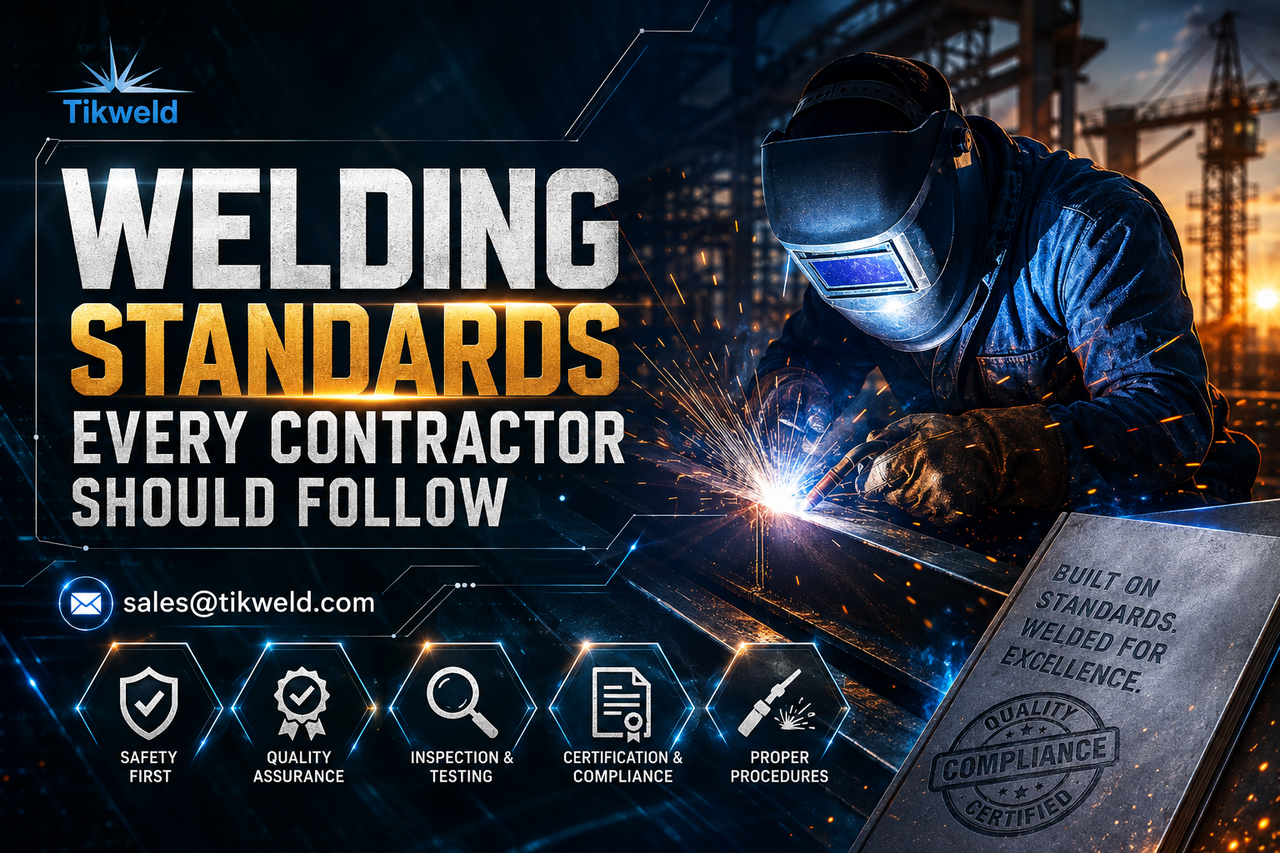
A good weld isn't just about appearance. It's about safety, quality, procedure, and compliance.
When you're working on structural steel, pipelines, industrial equipment, or fabrication projects, following the right welding standards can help reduce defects, rework, equipment damage, and safety risks.
Quick Check
What type of welding work do you handle?
| Project | Standards / Guidance to Check |
|---|---|
| Structural steel | AWS structural welding codes / project specifications |
| Industrial fabrication | ISO 3834 / applicable product standards |
| General fabrication | Applicable AWS/ISO standards and WPS |
| Pressure equipment | Applicable pressure-vessel code and project requirements |
| Workplace safety | Applicable occupational safety regulations |
| Welding & cutting operations | Welding, cutting and hot-work safety requirements |
AWS notes that it has more than 350 welding standards, including AWS D1.1 Structural Welding Code – Steel, one of the most widely referenced welding codes. (American Welding Society)
1. Follow the Correct Welding Code
Don't start welding before you know which code applies to the job.
Different projects can require different standards.
Contractor Checklist
☐ Identify the applicable welding code
☐ Review project specifications
☐ Confirm material requirements
☐ Confirm welding process
☐ Check required weld quality
☐ Document applicable procedures
2. Use a Qualified Welding Procedure
A professional welding operation shouldn't depend on guesswork.
Your Welding Procedure Specification (WPS) should define the important variables needed to produce the required weld.
| Check | Confirm |
|---|---|
| Base material | ✅ |
| Welding process | ✅ |
| Electrode/filler | ✅ |
| Amperage | ✅ |
| Voltage | ✅ |
| Travel speed | ✅ |
| Preheat/interpass requirements | ✅ |
| Shielding gas | ✅ |
Pro Tip: Keep the applicable WPS available to welders at the work location.
3. Make Sure Welders Are Qualified
The machine can be excellent, but the result still depends on the person operating it.
Before assigning a welder to critical work:
CHECK → QUALIFICATION → PROCESS → MATERIAL → POSITION
Don't assume that experience with one welding process automatically qualifies someone for another.
4. Inspect Materials Before Welding
Bad material preparation = bad weld.
Before striking an arc:
| Inspect | Look For |
|---|---|
| Base metal | Correct grade and thickness |
| Joint | Correct fit-up |
| Surface | Oil, rust, paint or contamination |
| Edges | Correct preparation |
| Consumables | Correct type and condition |
5. Use the Right Welding Machine
The welding machine should match the material, thickness, process, and application.
Which machine are you using?
TIG → Precision & stainless steel
MIG → Speed & production
MMA/Stick → Repairs & outdoor work
Multi-process → Multiple welding applications
Contractor Tip
Don't select a machine simply because it has a high amperage rating.
Consider:
Amperage + Duty Cycle + Welding Process + Material + Power Supply
6. Don't Ignore PPE & Site Safety
Welding creates multiple hazards, including heat, sparks, fumes, UV radiation, electrical hazards and fire risks.
A proper welding setup should include appropriate:
| PPE / Safety Equipment | Purpose |
|---|---|
| Welding helmet | Eye & face protection |
| Welding gloves | Hand protection |
| Protective clothing | Heat & spark protection |
| Safety boots | Foot protection |
| Respiratory protection | Where required by hazard assessment |
| Welding screens | Protect nearby workers |
OSHA's welding requirements cover welding, cutting and brazing, while its PPE standards address areas including eye/face, respiratory, head, foot, hand and electrical protection. (OSHA)
Shop Welding Safety Equipment →
7. Control Fire & Hot-Work Hazards
Before welding:
HOT-WORK CHECK
☐ Remove combustible materials
☐ Check the surrounding area
☐ Provide appropriate fire protection
☐ Inspect cables and connections
☐ Check gas cylinders and hoses
☐ Provide adequate ventilation
☐ Follow the site's hot-work requirements
Never treat welding as an ordinary workshop activity.
8. Inspect the Finished Weld
The weld isn't finished when the arc stops.
Depending on the project requirements, inspection may include:
Visual Inspection → Dimensional Check → NDT → Documentation
Possible non-destructive testing methods include:
-
Visual Testing (VT)
-
Dye Penetrant Testing (PT)
-
Magnetic Particle Testing (MT)
-
Ultrasonic Testing (UT)
-
Radiographic Testing (RT)
ISO 3834 provides quality requirements for fusion welding of metallic materials and applies to both workshop manufacturing and field installation. (ISO)
9. Keep Welding Records
For professional contractors, documentation matters.
Keep records where required for:
-
WPS
-
Welder qualifications
-
Material certificates
-
Consumables
-
Inspection results
-
NDT reports
-
Repairs
-
Project specifications
If you can't document it, proving compliance becomes much harder.
Contractor's 30-Second Welding Checklist
Before starting the job, ask:
| Question | ✓ |
|---|---|
| Do I know the applicable welding code? | ☐ |
| Is the welder qualified for the work? | ☐ |
| Is the WPS available? | ☐ |
| Is the material correctly identified? | ☐ |
| Is the welding machine suitable? | ☐ |
| Are consumables correct? | ☐ |
| Is PPE available? | ☐ |
| Is the work area safe? | ☐ |
| Are fire controls in place? | ☐ |
| Is inspection planned? | ☐ |
Choose the Right Equipment for the Job
Building a professional welding setup?
| Need | Explore |
|---|---|
| Welding Machines | View Machines → |
| TIG Welding | Shop TIG Welders → |
| MIG Welding | Shop MIG Welders → |
| MMA/Arc Welding | Shop Arc Welders → |
| Welding Electrodes | Shop Electrodes → |
| Welding PPE | Shop Safety Equipment → |
| Welding Accessories | View Accessories → |
Important Note
Standards vary by project and location. AWS, ISO and local/regulatory requirements are not interchangeable, and a contractor should follow the standard specified by the project, applicable law, client, engineer, or authority having jurisdiction. OSHA's requirements, for example, are U.S. regulations and should not be presented as Nigerian law. (OSHA)
For an international-facing Tikweld article, I would therefore use AWS and ISO as technical references, while adding a short note directing Nigerian contractors to comply with applicable Nigerian regulations and project specifications.
Newest Guide & Blog Updates

Free Online Epoxy Flooring Training in Nigeria Scheduled for October 2026
Professionals, artisans, contractors and individuals interested in epoxy flooring will have an oppor...
Epoxy Resin and Hardener Mixing Ratio: A Complete Guide
Introduction If you are using epoxy resin for flooring, coating, casting or other applications, one...

How Much Epoxy Resin Do You Need for Flooring? Coverage & Calculation Guide
How Much Epoxy Resin Do You Need for Flooring? Coverage & Calculation Guide Calculating the amount o...
How to Remove Heavy Oil and Grease from Industrial Equipment
Introduction Heavy oil, grease and industrial grime can build up on machinery, engines, mechanical c...
Antirust Degreaser: How It Cleans and Protects Metal Surfaces
Introduction Industrial equipment and metal components are often exposed to two common maintenance p...
Citrus Degreaser vs Heavy-Duty Degreaser: What's the Difference?
Introduction Oil, grease and industrial dirt can build up on machinery, workshop equipment, metal su...