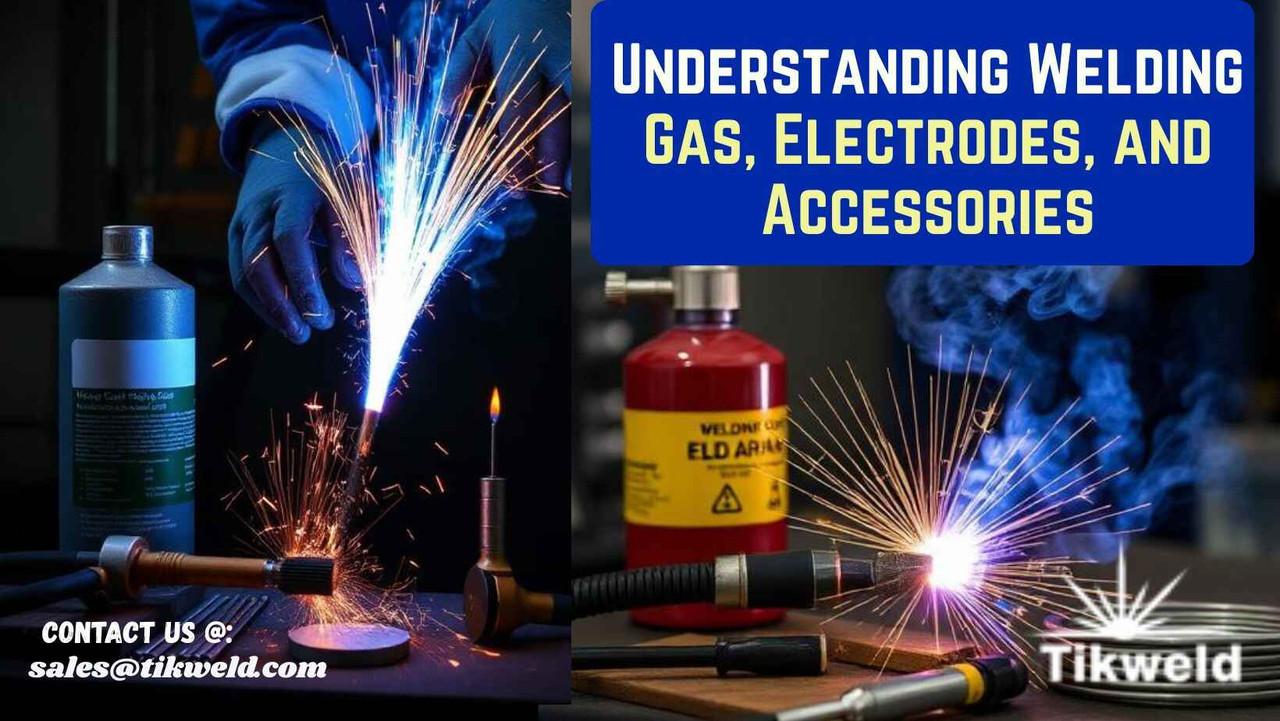
Understanding Welding Gas, Electrodes, and Accessories
Introduction

Successful welding is not determined by the welding machine alone. In practice, the quality, strength, and safety of a weld depend heavily on the correct selection of welding gas, electrodes, and accessories. Even the most advanced welding machine will produce poor results if the wrong consumables or accessories are used.

In industrial environments such as fabrication workshops, construction sites, oil & gas facilities, and manufacturing plants, incorrect welding consumables can lead to weak welds, excessive spatter, porosity, rework, safety hazards, and increased operating costs.

This guide explains how welding gas, electrodes, and accessories work, why they are essential, and how to choose the right combination for different welding processes and materials.

Overview of Welding Consumables

Welding consumables are materials that are used up or wear out during the welding process. Unlike welding machines, which are long-term assets, consumables require regular replacement and directly affect weld quality.

Key Categories of Welding Consumables

  • Welding gases – protect and stabilize the weld

  • Electrodes and filler materials – create and shape the weld

  • Accessories – deliver power, control gas flow, and ensure operator safety

Selecting the correct consumables ensures:

  • Stronger, defect-free welds

  • Reduced downtime and rework

  • Improved safety for welders

  • Lower long-term maintenance costs

Understanding Welding Gases

What Welding Gas Does

Welding gas plays a critical role in most modern welding processes. Its primary function is to shield the molten weld pool from atmospheric contamination such as oxygen, nitrogen, and hydrogen.

Without proper shielding:

  • Welds become porous and brittle

  • Oxidation weakens joint strength

  • Arc stability is reduced

  • Weld appearance and penetration suffer

In addition to shielding, welding gas also:

  • Controls arc behavior

  • Influences penetration depth

  • Affects spatter levels and bead shape

Common Types of Welding Gases

Different welding processes and materials require different gases. The most commonly used welding gases include:

Argon

  • Widely used for TIG welding and aluminum welding

  • Produces a smooth, stable arc

  • Provides excellent shielding for non-ferrous metals

  • Often mixed with other gases for MIG welding

Carbon Dioxide (CO₂)

  • Common in MIG welding of mild steel

  • Affordable and readily available

  • Provides deep penetration but produces more spatter

  • Popular in heavy fabrication and structural welding

Argon–CO₂ Gas Mixtures

  • Combines arc stability with penetration control

  • Reduces spatter compared to pure CO₂

  • Frequently used for MIG welding in workshops and industrial settings

Oxygen and Acetylene

  • Used in gas welding and cutting

  • Suitable for cutting, brazing, and light fabrication work

  • Requires strict safety handling procedures

Choosing the Right Welding Gas

Selecting the correct welding gas depends on:

  • Welding process (MIG, TIG, ARC, gas welding)

  • Base material (mild steel, stainless steel, aluminum)

  • Weld position and thickness

  • Cost and availability

Using the wrong gas can result in poor weld penetration, excessive spatter, or structural weakness—especially in load-bearing applications.

Understanding Welding Electrodes

What Are Welding Electrodes?

Welding electrodes are conductive materials that carry electrical current to create the welding arc. In many processes, they also act as the filler material that joins metals together.

Electrodes fall into two main categories:

  • Consumable electrodes – melt and become part of the weld

  • Non-consumable electrodes – do not melt and require separate filler material

Choosing the correct electrode is essential for achieving strong, reliable welds and ensuring compatibility with the welding process and base material.

Types of Welding Electrodes

Stick Welding (SMAW) Electrodes

  • Common types include E6013, E7018, and E6011

  • Suitable for mild steel and structural welding

  • Easy to use and ideal for outdoor or field work

TIG Welding Electrodes

  • Made from tungsten

  • Available in different types based on additives

  • Used for precision welding of stainless steel and aluminum

MIG Welding Wires

  • Solid wire or flux-cored wire

  • Fed continuously through the welding torch

  • Used for fast, efficient welding in production environments

Understanding Welding Accessories

Welding accessories are the supporting components that control power delivery, gas flow, and operator safety. While often overlooked, worn or incorrect accessories are among the most common causes of poor weld quality and safety incidents.

Gas-Related Welding Accessories

Gas Regulators

Regulators control the pressure of gas flowing from the cylinder to the welding torch. A faulty regulator can lead to:

  • Inconsistent gas flow

  • Weld porosity

  • Gas wastage

Choosing a quality regulator ensures steady pressure and accurate flow control.

Flow Meters

Flow meters measure the actual gas flow rate to the torch. Incorrect flow settings can:

  • Expose the weld pool to air (low flow)

  • Cause turbulence and contamination (excessive flow)

Proper flow rates improve shielding efficiency and weld appearance.

Gas Hoses

Hoses transport gas safely from the cylinder to the torch. Damaged or leaking hoses can:

  • Reduce shielding effectiveness

  • Create safety hazards

Regular inspection and replacement are essential.

Flashback Arrestors

Flashback arrestors prevent flames from traveling back into gas hoses or cylinders. These are critical safety devices, especially in gas welding and cutting operations.

Electrical & Welding Accessories

Electrode Holders

Electrode holders grip stick electrodes securely and transmit current. Poor-quality holders can cause:

  • Arc instability

  • Overheating

  • Operator fatigue

Heavy-duty holders are recommended for industrial applications.

Welding Cables

Cables deliver electrical power from the machine to the electrode holder or torch. Undersized or damaged cables lead to:

  • Voltage drop

  • Weak arc performance

  • Excessive heat buildup

Using the correct cable size improves efficiency and safety.

Ground Clamps

A reliable ground connection is essential for stable arc formation. Loose or corroded clamps result in erratic welding and poor fusion.

Safety Accessories Every Welder Needs

  • Welding helmets (auto-darkening preferred)

  • Heat-resistant gloves

  • Protective clothing

  • Eye and respiratory protection

  • Basic fume extraction for enclosed spaces

Safety accessories protect the welder and ensure compliance with workplace standards.


Matching Gas, Electrodes, and Accessories by Welding Process

Correct matching of consumables and accessories ensures consistent weld quality.

MIG Welding Setup

  • Gas: Argon–CO₂ mix or pure CO₂ (for mild steel)

  • Electrode: Solid wire or flux-cored wire

  • Accessories: Regulator, flow meter, MIG torch, proper grounding

This setup is ideal for fabrication shops and production welding.

TIG Welding Setup

  • Gas: Pure argon

  • Electrode: Tungsten (non-consumable)

  • Accessories: Flow meter, TIG torch, filler rods

TIG welding provides high precision and clean welds, especially for stainless steel and aluminum.

Stick Welding (ARC) Setup

  • Gas: Not required

  • Electrode: E6013, E7018, E6011

  • Accessories: Heavy-duty electrode holder, welding cables, ground clamp

Stick welding is suitable for outdoor and field applications.

Common Welding Consumable Mistakes

Using the Wrong Gas

Incorrect gas selection leads to:

  • Porosity

  • Excessive spatter

  • Weak weld penetration

Incorrect Electrode Choice

Using the wrong electrode type or size can cause cracking, poor fusion, and structural weakness.

Poor Gas Flow Settings

Too little or too much gas disrupts shielding and compromises weld integrity.

Neglecting Accessories Maintenance

Worn cables, leaking hoses, and damaged holders reduce welding performance and increase safety risks.

Cost Considerations in Nigeria

In Nigeria, the cost of welding consumables depends on:

  • Gas type and refill frequency

  • Electrode brand and quality

  • Accessory lifespan and durability

While cheaper consumables may reduce upfront costs, they often increase long-term expenses through rework, downtime, and equipment damage.


Storage, Handling & Safety Best Practices

Proper storage and handling of welding gas, electrodes, and accessories are essential to maintain quality and ensure safety.

Welding Gas Storage

  • Store gas cylinders upright and secure them properly

  • Keep cylinders away from heat sources and direct sunlight

  • Always close cylinder valves when not in use

  • Inspect regulators, hoses, and fittings regularly for leaks

Electrode Storage

  • Store welding electrodes in a dry environment

  • Moisture exposure can cause hydrogen-induced cracking

  • Low-hydrogen electrodes (such as E7018) should be kept in heated storage or sealed containers

  • Discard electrodes showing visible damage or contamination

Accessory Maintenance

  • Inspect cables, holders, clamps, and hoses before use

  • Replace damaged components immediately

  • Clean contact points regularly to maintain good electrical conductivity

Frequently Asked Questions (FAQs)

Which gas is best for MIG welding?

Argon–CO₂ mixtures are commonly preferred for MIG welding because they provide good arc stability, penetration, and reduced spatter. Pure CO₂ is also used for mild steel due to its affordability.

Can CO₂ be used instead of argon?

Yes, CO₂ can be used for MIG welding on mild steel, but it produces more spatter and a rougher weld finish compared to argon-based mixtures.

What electrode is best for mild steel welding?

E6013 and E7018 electrodes are widely used for mild steel. E6013 is easy to use, while E7018 offers higher strength and lower hydrogen content.

Do accessories really affect weld quality?

Yes. Poor-quality regulators, cables, or clamps can cause unstable arcs, gas leaks, and inconsistent weld penetration, leading to weak welds.

How often should welding accessories be replaced?

Accessories should be replaced as soon as they show signs of wear, damage, or reduced performance. Preventive replacement is safer and more cost-effective.


Where to Buy Welding Gas, Electrodes, and Accessories

Purchasing welding consumables from a reliable supplier ensures:

  • Authentic, high-quality products

  • Consistent availability

  • Technical guidance and after-sales support

  • Competitive pricing for bulk and industrial buyers

Look for suppliers with proven experience serving fabrication shops, industrial plants, and construction projects.


Expert Recommendation

Understanding and correctly matching welding gas, electrodes, and accessories is critical to achieving strong, clean, and reliable welds. When consumables are selected properly and maintained correctly, welders experience:

  • Improved weld quality

  • Reduced defects and rework

  • Increased safety

  • Lower long-term operating costs

For Nigerian welders, fabricators, and industrial users, investing in the right welding consumables is not an expense—it is a productivity decision.


Need help selecting the right welding gas, electrodes, or accessories?

Speak with a welding specialist to get expert guidance based on your application, material type, and budget.


If you’d like next, I can:

24th Dec 2025 Tikweld Team

Newest Guide & Blog Updates